EPA Proposes Interim Plan to Address Groundwater Contamination at the Welsbach/General Gas Mantle


Image


CONTACT: mcbay.stephen@epa.gov
 

EPA Proposes Interim Plan to Address Groundwater Contamination at the Welsbach/General Gas Mantle Superfund Site in Gloucester City and Camden, N.J.

NEW YORK (August 24, 2021) – The U.S. Environmental Protection Agency (EPA) has proposed an interim plan to address groundwater contaminated with radium at the Welsbach/General Gas Mantle Superfund site located in Camden and Gloucester City, New Jersey. EPA is taking public comment on its plan and will host a virtual public meeting on September 8.

"This proposed plan continues EPA's work to protect residents of Gloucester City and Camden from contamination associated with this site. Having already taken many actions to address the source of contamination, in this case we are focusing on contaminated groundwater," said Acting Regional Administrator Walter Mugdan. "This is an interim plan that we propose to implement as we continue to assess the groundwater to see if we need to do more to address it in the long term. We feel this interim plan is the best approach and we look forward to continue to work closely with the impacted communities."

EPA is proposing an interim cleanup plan, called a remedy, which will allow natural processes to break down radioactive elements in the groundwater into less harmful substances, coupled with putting into place institutional controls, such as restrictions on the use of the impacted groundwater, and conducting long-term monitoring of the groundwater to ensure that the breakdown of radioactive elements is happening as anticipated. EPA reached its decision based on information including results of the sampling of the groundwater between 2018 and 2020.

This Welsbach/General Gas Mantle Superfund site is divided into four phases of work called operable units, which are discrete pieces of the wider cleanup effort. This proposed plan addresses the fourth operable unit (OU4), which is groundwater. Under a cleanup plan for operable unit 1 (OU1) EPA is currently addressing radiologically impacted soil in the study area in Gloucester City, New Jersey. The interim remedy proposed today would be implemented during the OU1 cleanup of the radiologically contaminated soil. Once that soil, which is a source of groundwater contamination, is fully addressed the interim groundwater remedy will be reevaluated and EPA will establish a permanent groundwater cleanup plan.

EPA completed the cleanup work for OU2 in 2017, which included decontaminating building surfaces at the Armstrong Building (the last remaining building from Welsbach's gas mantle operations) and disposing of the radiologically contaminated soil/waste to an approved off-site location. After careful study, EPA determined that no cleanup action was needed for OU3, which includes wetlands, surface water, and sediment as they posed no radiological threat to people or the environment.

EPA will continue to monitor the groundwater and will conduct a review of the site conditions at least every five years to ensure the effectiveness of the interim remedy. Work under today's proposed plan is estimated to cost $460,000.

The EPA will hold a virtual public meeting to discuss its proposed interim plan on September 8, 2021, at 6:00 pm. To register for the public meeting, please visit https://welsbach-ggm.eventbrite.com.

Written comments on the proposed plan, postmarked no later than close of business September 24, 2021, can be mailed or emailed to Thomas Dobinson, Remedial Project Manager, U.S. Environmental Protection Agency, 290 Broadway – 19th Floor, New York, NY 10007, Email: dobinson.thomas@epa.gov

For site background and to view the proposed interim plan, visit: https://www.epa.gov/superfund/welsbach-ggm

Follow EPA Region 2 on Twitter at http://twitter.com/eparegion2 and visit our Facebook page, http://facebook.com/eparegion2

21-052


EPA  @epa

Image


If you would rather not receive future communications from Environmental Protection Agency, let us know by clicking here.
Environmental Protection Agency, 290 Broadway, New York,, NY 10007-1866 United States

ICYMI: From the Bay Area to the Border, EPA Administrator Michael S. Regan’s Week in California


https://us.vocuspr.com/Publish/518041/vcsPRAsset_518041_118775_892983fa-900b-4da8-a764-5c9b4334acfb_0.jpg

ICYMI: From the Bay Area to the Border, EPA Administrator Michael S. Regan's Week in California

WASHINGTON (August 23, 2021) – In case you missed it, EPA Administrator Michael S. Regan traveled to California last week, making stops in San Francisco, Silicon Valley, Venice Beach, Ventura, Los Angeles, San Diego and the US-Mexico border. During the swing, Administrator Regan spoke about the Bipartisan Infrastructure Deal and the Biden-Harris Administration's Build Back Better priorities.

During the trip, Administrator Regan:

  • met with business leaders in Silicon Valley to discuss technology that will drive us towards a zero-emission future,
  • visited Apple HQ for a tour and conversation on climate action with former EPA Administrator Lisa Jackson,
  • toured wildfire recovery efforts with Governor Gavin Newsom,
  • joined Congresswoman Julia Brownley to highlight efforts in Ventura to improve the sustainability and reliability of vulnerable supplies through water recycling projects
  • highlighted the Administration's commitment to environmental justice while touring Los Angeles County neighborhoods that are overburdened by pollution with Congresswoman Nanette Diaz Barragán.
  • announced $288 million in water infrastructure loans, highlighting the urgent need for water infrastructure investment.

Administrator Regan also fit in a workout, meeting up with former CA governor Arnold Schwarzenegger for a trip to the gym and a conversation about reducing pollution and protecting the environment.

Below are highlights from the Administrator's travel to California:
 

Driving Toward a Zero-Emission Future

While in Silicon Valley, Administrator Regan highlighted cutting edge electric and autonomous vehicle technology being developed in California, where he had the opportunity to tour Volta Charging, one of the most utilized electric vehicle charging networks in the country, and Zoox, a leader in green mobility and transportation. Administrator Regan also met Silicon Valley business leaders to discuss climate action and support for technology that will help drive us toward a zero-emission future.

Image           Image

See more from the Administrator's visit to Volta and Zoox HERE.


Administrator Regan Announces $168 Million in Water Investments in Silicon Valley

Administrator Regan also announced millions in water infrastructure loans while in Silicon Valley, which was covered in The Mercury News:

At an event hosted by Silicon Valley Clean Water Tuesday at the agency's new wastewater treatment plant currently under construction in Redwood Shores, Regan announced two Water Infrastructure Finance and Innovation Act loans totaling $143 million to SVCW and $25 million to the Oro Loma Sanitary District supporting projects expected to create more than 2,500 jobs.

"Investing in water infrastructure has proven time and again to deliver a multitude of benefits, including building climate and drought-resilient water systems, safeguarding public health, and creating good-paying jobs," Regan said. "Today's announcements embody the promise of the Bipartisan Infrastructure Deal, which will broaden the scope of these powerful benefits for communities across the nation."

Read the full article on the WIFIA loans to Silicon Valley HERE.


Administrator Regan visits Apple HQ to Talk Climate, Environmental Justice

Before departing Silicon Valley, Administrator Regan stopped by Apple for a tour and conversation with Lisa Jackson, former EPA administrator and head of Environment, Policy, and Social Initiatives at Apple. The conversation between the two first Black Administrators of the EPA spanned environmental justice, climate action and equity. The tour and conversation was featured in Axios:

Regan told Axios in an interview that the agency is seeking to partner with private companies such as Apple that are pursuing environmental goals that are consistent with the administration's focus on climate and environmental justice.

"It's important that we truly understand what companies like Apple are doing so that we can take advantage of this moment, and the resources that are being made available to us," Regan said, referencing the money for environmental justice initiatives contained in the bipartisan infrastructure bill.


Read more about Administrator Regan's trip in Axios HERE and from CNBC HERE.


Governor Newsom, Administrator Regan Visit CZU Lightning Complex Wildfire Site

On Tuesday, Administrator Regan joined Governor Gavin Newsom for a visit to the CZU Lighting Complex Wildfire site, touring damage one year after the fire and discussing how EPA and California are moving with urgency to tackle the climate crisis. The Governor and the Administrator spoke about the challenging wildfire conditions currently facing Californians – conditions that are becoming more frequent and extreme due to the climate crisis, and how state and federal partners can work together to solve the crisis that's fueling these devastating fires, and in the meantime, help communities stay safe and recover in the aftermath.   

Gov. Gavin Newsom and U.S. EPA Administrator Michael Regan

Read more about the visit to the CVU Lighting Complex Wildfire site from KION CBS HERE.


Administrator Regan and Arnold Schwarzenegger Team Up to Terminate Pollution

Later in the week, the Administrator met up with former CA governor Arnold Schwarzenegger at Gold's Gym in Venice Beach for an early morning work-out. Following the workout, they spoke about a shared commitment to climate action, the importance of state-federal partnerships to tackle pollution, and how they can work together moving forward.

WATCH a clip of the workout and conversation on EPA's YouTube page HERE.


Congresswoman Brownley and Administrator Regan Tour of Ventura Water Project, Highlight Benefits of Investing in Critical Community Infrastructure

On Wednesday, Administrator Regan joined Congresswoman Julia Brownley to highlight efforts in Ventura to improve the sustainability and reliability of vulnerable supplies through water recycling projects. From coverage in the Ventura County Star:

EPA Administrator Michael Regan toured Ventura's water recycling facility Wednesday afternoon, collecting data under the proposed bipartisan infrastructure deal.

"It's important that we have an understanding of what we're dealing with all across the country," said Regan, who is on a national tour of similar facilities.

Environmental Protection Agency officials are determining how to best utilize resources that are discussed in the infrastructure deal, he said.

Read the full article from the Ventura County Star HERE.


Congresswoman Barragán and Administrator Regan Meet with Local Activists in Los Angeles County to Highlight Environmental Justice Issues

On Thursday, Administrator Regan met up with Congresswoman Nanette Diaz Barragán for a tour of neighborhoods in her district severely affected by pollution and a conversation with Los Angeles County residents who live near these polluted sites. From coverage in the Daily Breeze:

Barragán and Regan toured neighborhoods within the 44th Congressional District to target issues of pollution and air quality, including oil drilling sites not far from local homes and the Boys & Girls Club.

Wilmington has long been a focal point for concern about pollution, as it resides in an area that includes many lower-income neighborhoods fronted by refineries and oil production sites, as well as being crisscrossed by heavy truck traffic from the twin ports of Los Angeles and Long Beach.

The Biden administration has vowed to aim for "environmental justice" in such zones, promising to reduce environmental contaminants in impoverished areas.

Read more about the visit and discussion from the Daily Breeze HERE.


San Diego Officials and Administrator Regan Announce $120 million WIFIA Loan, Highlight Benefits of Water Infrastructure Investment

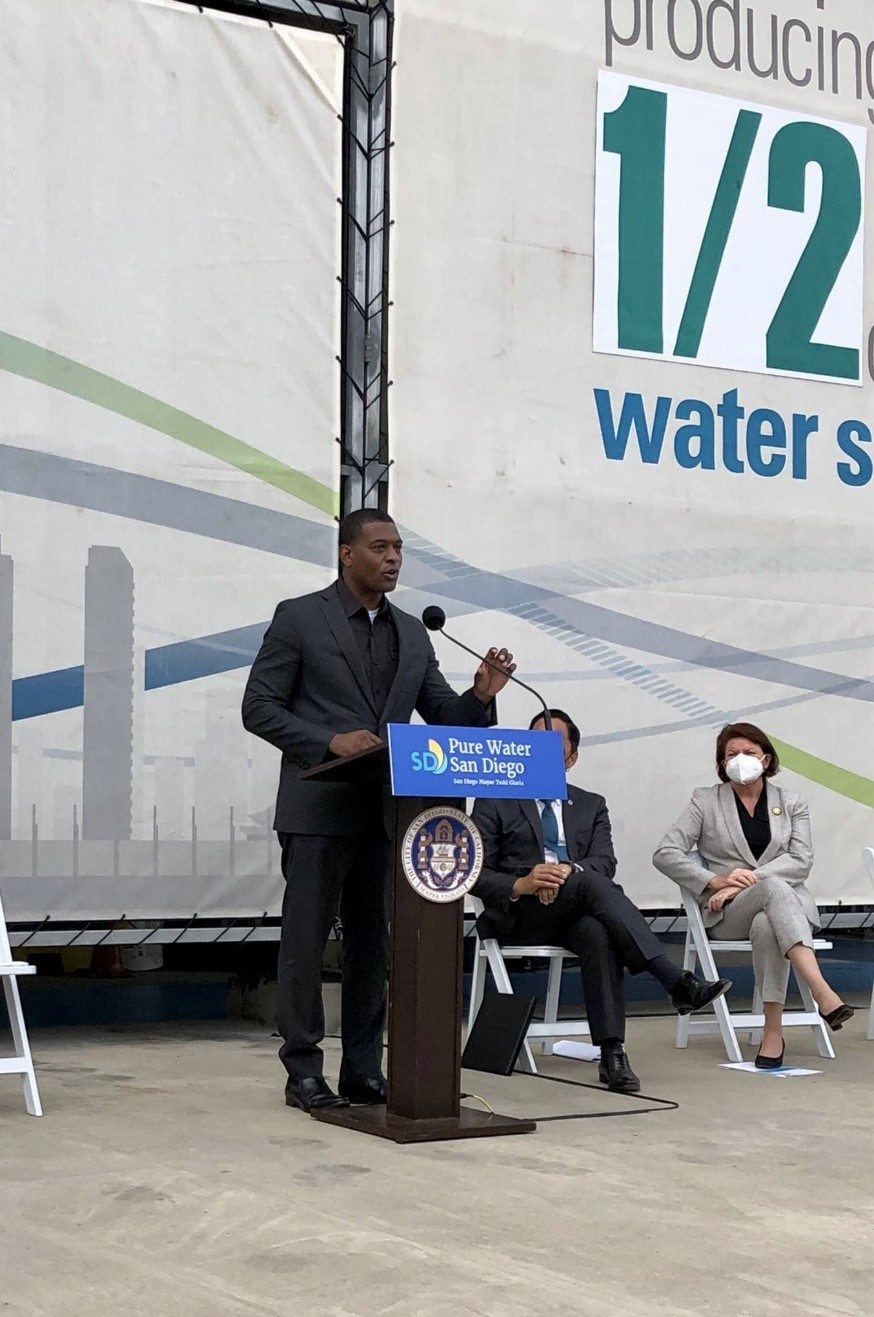
On Friday, Administrator Regan continued to highlight the benefits of water infrastructure investments, joining San Diego elected and local officials to announce an additional $120 million WIFIA loan and participate in the groundbreaking of the Pure Water San Diego water recycling facility, which will produce 30 million gallons per day of purified water when complete.

Read more about the $120 million WIFIA loan to San Diego from NBC San Diego 7 HERE.


Administrator Regan visits U.S.-Mexico Border to Tour Infrastructure, Highlight Pollution Concerns Along San Diego Beaches

At the end of the California swing, the Administrator made a stop at the U.S.-Mexico Border, touring border infrastructure and discussing the need for long-term solutions to eliminate pollution at the border. From coverage in the San Diego Union-Tribune:

U.S. Environmental Protection Agency Administrator Michael Regan got a first-hand look Friday at the Tijuana River Valley, where hundreds of millions of gallons of water laced with raw sewage, trash and industrial chemicals regularly foul San Diego shorelines, shuttering beaches as far north as Coronado.

"You know, you can read about these things and have your own visualization, but seeing it first-hand really is impactful," said Regan, the first EPA administrator to tour the local border region.

He had plenty to see. On Tuesday, 1.8 million gallons of urban runoff that included untreated sewage flowed across the border at the Tijuana River after a pump station on the Mexico side of the border was temporarily shut down for emergency repairs, according to the International Water Boundary and Water Commission, the U.S. federal agency tasked with monitoring cross-border flows.

Read more about the Administrator's visit to the border in the San Diego Union-Tribune HERE.

###


EPA  @epa

Image


If you would rather not receive future communications from US EPA, Office of Public Engagement, let us know by clicking here.
US EPA, Office of Public Engagement, 1200 Pennsylvania Avenue NW, Washington, DC 20460 United States

EPA Takes Action to Address Risk from Chlorpyrifos and Protect Children’s Health


https://us.vocuspr.com/Publish/518041/vcsPRAsset_518041_118775_892983fa-900b-4da8-a764-5c9b4334acfb_0.jpg

EPA Takes Action to Address Risk from Chlorpyrifos and Protect Children's Health

EPA measures will stop the use of the pesticide chlorpyrifos on food

WASHINGTON (August 18, 2021) - The U.S. Environmental Protection Agency (EPA) announced it will stop the use of the pesticide chlorpyrifos on all food to better protect human health, particularly that of children and farmworkers.

In a final rule released today, EPA is revoking all "tolerances" for chlorpyrifos, which establish an amount of a pesticide that is allowed on food.  In addition, the agency will issue a Notice of Intent to Cancel under the Federal Insecticide, Fungicide, and Rodenticide Act to cancel registered food uses of chlorpyrifos associated with the revoked tolerances.

"Today EPA is taking an overdue step to protect public health. Ending the use of chlorpyrifos on food will help to ensure children, farmworkers, and all people are protected from the potentially dangerous consequences of this pesticide," said Administrator Michael S. Regan. "After the delays and denials of the prior administration, EPA will follow the science and put health and safety first."

Chlorpyrifos is an organophosphate insecticide used for a large variety of agricultural uses, including soybeans, fruit and nut trees, broccoli, cauliflower, and other row crops, as well as non-food uses. It has been found to inhibit an enzyme, which leads to neurotoxicity, and has also been associated with potential neurological effects in children.

The steps the agency is announcing today respond to the Ninth Circuit's order directing EPA to issue a final rule in response to the 2007 petition filed by Pesticide Action Network North America and Natural Resources Defense Council. The petition requested that EPA revoke all chlorpyrifos tolerances, or the maximum allowed residue levels in food, because those tolerances were not safe, in part due to the potential for neurodevelopmental effects in children.

Under the previous Administration, EPA denied the petition in 2017 and denied the subsequent objections in 2019. These denials were challenged in the Ninth Circuit Court of Appeals in 2019 by a coalition of farmworker, health, environmental, and other groups.  In April 2021, the Court found that "...EPA had abdicated its statutory duty under the Federal Food, Drug and Cosmetic Act..." to "conclude, to the statutorily required standard of reasonable certainty, that the present tolerances caused no harm." In its decision, the Court ordered EPA to grant the petition, issue a final rule in which the agency either modifies the chlorpyrifos tolerances with a supporting safety determination or revokes the tolerances, and modify or cancel food-use registrations of chlorpyrifos.

EPA has determined that the current aggregate exposures from use of chlorpyrifos do not meet the legally required safety standard that there is a reasonable certainty that no harm will result from such exposures. A number of other countries, including the European Union and Canada, and some states including California, Hawaii, New York, Maryland, and Oregon have taken similar action to restrict the use of this pesticide on food.

While farmers have historically relied on chlorpyrifos, its use has been in decline due to restrictions at the state level and reduced production. Additionally, some alternatives have been registered in recent years for most crops. There are also other chemistries and insect growth regulators available for certain target pests. EPA is committed to reviewing replacements and alternatives to chlorpyrifos.

The U.S. has a safe and abundant food supply, and children and others should continue to eat a variety of foods, as recommended by the federal government and nutritional experts. Washing and scrubbing fresh fruits and vegetables will help remove traces of bacteria, chemicals, and dirt from the surface. Very small amounts of pesticides that may remain in or on fruits, vegetables, grains, and other foods decrease considerably as crops are harvested, transported, exposed to light, washed, prepared, and cooked.

This action will also be incorporated into the ongoing registration review for chlorpyrifos. EPA is continuing to review the comments submitted on the chlorpyrifos proposed interim decision, draft revised human health risk assessment, and draft ecological risk assessment. These documents are available in the chlorpyrifos registration review docket EPA-HQ-OPP-2008-0850 at www.regulations.gov.

After considering public comments, the agency will proceed with registration review for the remaining non-food uses of chlorpyrifos by issuing the interim decision, which may consider additional measures to reduce human health and ecological risks. More information on the registration review process is available here.

More information about chlorpyrifos and the final tolerance rule is available on EPA's website


EPA  @epa

Image


If you would rather not receive future communications from US EPA, Office of Public Engagement, let us know by clicking here.
US EPA, Office of Public Engagement, 1200 Pennsylvania Avenue NW, Washington, DC 20460 United States

ENERGY STAR Expands Efforts to Improve Energy Efficiency of U.S. Data Centers

News Release Issued: Aug 16, 2021 (11:49am EDT)

If you wish to unsubscribe please do so here: https://epa.mediaroom.com/index.php?s=20300&unsub=1&hide_page_content=1

ENERGY STAR Expands Efforts to Improve Energy Efficiency of U.S. Data Centers

WASHINGTON – (August 16, 2021) Today, the U.S. Environmental Protection Agency (EPA) is announcing expanded efforts to drive energy efficiency improvements among U.S. data centers. Through its ENERGY STAR program, EPA has launched an updated specification for ENERGY STAR certification of data storage products, unveiled a brand-new website experience designed to serve as the go-to place for data center energy efficiency resources, and will be updating its 1-100 ENERGY STAR score for data centers. 

"The data center computing sector is growing rapidly. Reducing the sector's annual 70 billion-plus kWh use is essential to fighting the climate crisis," said Joseph Goffman, Principal Deputy Assistant Administrator for EPA's Office of Air and Radiation. "The ENERGY STAR updates EPA is announcing today will lead the industry towards greater innovation and deep carbon savings."

Ten years ago, data center energy use was predicted to grow exponentially as digital computing expanded. However, gains in energy efficiency—both at the network hardware and storage level, as well as at the building level—have mostly offset this growth. Between 2010 and 2018, data center computing grew by 500 percent, while data center energy use only grew by six percent. ENERGY STAR played a significant role in this progress, but much more is required as digital computing data needs continue to grow rapidly.

EPA's ENERGY STAR program has been a critical player in the drive to improve the energy efficiency of data centers. Data center equipment that earns the ENERGY STAR label is independently certified to meet strict efficiency specifications set by the EPA. For example, labeled computer servers are on average 30% more efficient than non-certified products. In addition to servers, eligible products include uninterruptible power supplies, data center storage, and large network equipment like switches and routers.

Earlier this year, EPA released an updated ENERGY STAR specification for data center storage products, adding active-mode requirements and requiring more efficient power supplies. The program also added new how-to content and case studies to its website.

ENERGY STAR also provides data center owners and operators with a 1-100 ENERGY STAR score that rates the energy efficiency of their entire facility compared to similar facilities nationwide, as well as ENERGY STAR certification to those that out-perform their peers.

More than 190 data centers representing nearly 30 million square feet of floor space have earned EPA's ENERGY STAR certification. The ENERGY STAR score for data centers was first launched in 2010 and is based on 2008 survey data. Since then, the number of data centers has grown substantially, and much work has been done to improve their energy efficiency.

This fall, to ensure that the ENERGY STAR score continues to give data center owners and operators an up-to-date picture of their performance, EPA will partner with The Green Grid, a leading data center industry association, to conduct a survey of data centers' energy and water use. EPA intends to use the survey results to update its 1-100 ENERGY STAR score for data centers.

Data centers are one of the most energy-intensive building types, consuming 10 to 50 times more energy per square foot than a typical office building. In 2014, data centers in the U.S. consumed an estimated 70 billion kWh, representing about 1.8% of total U.S. electricity consumption. Based on estimates in 2016, U.S. data centers were projected to consume approximately 73 billion kWh in 2020.

About ENERGY STAR

ENERGY STAR® is the government-backed symbol for energy efficiency, providing simple, credible, and unbiased information that consumers and businesses rely on to make well-informed decisions. Thousands of industrial, commercial, utility, state, and local organizations—including nearly 40 percent of the Fortune 500®—rely on their partnership with EPA to deliver cost-saving energy efficiency solutions. Together, since 1992, ENERGY STAR and its partners have helped American families and businesses save 5 trillion kilowatt-hours of electricity, avoid more than $450 billion in energy costs, and achieve 4 billion metric tons of greenhouse gas reductions, all through voluntary action. Learn more about ENERGY STAR at energystar.gov/about.

See a list of ENERGY STAR certified data centers: https://www.energystar.gov/buildings/certified_data_centers

Learn more about ENERGY STAR certified data center products: https://www.energystar.gov/products/data_centers

Learn more about ENERGY STAR for data centers: https://www.energystar.gov/buildings/tools-and-resources/energy-star-score-data-centers


To unsubscribe or change your settings click here:
https://epa.mediaroom.com/index.php?s=subscribe&code=VKqmF6An6Hl4dwUB39RicZ7OBkfMl6ohCQ

EPA News: EPA settlement with Kennedy Center protects water quality of Potomac River, Chesapeake Bay


Image

FOR IMMEDIATE RELEASE
Contact:
R3press@epa.gov

EPA agreement with Kennedy Center protects
water quality of Potomac River, Chesapeake Bay

PHILADELPHIA – (August 13, 2021) – The John F. Kennedy Center for the Performing Arts in Washington, D.C. has settled alleged Clean Water Act violations at its facility in Washington, D.C., the U.S. Environmental Protection Agency announced today.

The Kennedy Center, located at 2700 F St NW, has a Clean Water Act permit regulating its discharges of condenser cooling water from the facility's air conditioning system into the Potomac River, which is part of the Chesapeake Bay watershed. 

This settlement addresses alleged violations of temperature and pH discharge permit limits required under the Kennedy Center's Clean Water Act permit. EPA also cited the Kennedy Center for failing to timely submit monitoring reports and failing to submit pH influent data. Additionally, the agreement addresses alleged violations identified by the District of Columbia's Department of Energy and Environment during a prior inspection of the facility.

As part of the settlement, the Kennedy Center is required to submit a compliance implementation plan. The Kennedy Center has certified that it is now in compliance with permit requirements.

This agreement is part of EPA's National Compliance Initiative: Reducing Significant Non-Compliance with National Pollutant Discharge Elimination System (NPDES) Permits. For more information about the Clean Water Act permit program, visit www.epa.gov/npdes.


#          #          #


EPA  @epa

Image


If you would rather not receive future communications from Environmental Protection Agency, let us know by clicking here.
Environmental Protection Agency, 1650 Arch Street, Philadelphia, PA 19103-2029 United States

EPA News: LPG Land & Dev. Corp. to pay penalty to settle violations at Morgantown facility (WV)


Image

FOR IMMEDIATE RELEASE

Contact: R3press@epa.gov 

LPG Land & Development Corp to pay penalty, make stream improvement
to settle water violations at Morgantown facility


PHILADELPHIA (Aug. 9, 2021) – LPG Land & Development Corporation will pay a $125,000 penalty and pay more than $600,000 for stream restoration improvements to settle federal and state water pollution violations at the Mon Fayette Industrial Park in Morgantown, West Virginia, the U.S. Environmental Protection Agency and West Virginia Department of Environmental Protection (WVDEP) announced today.

The proposed consent decree was lodged this week by the U.S. Justice Department on behalf of EPA and WVDEP in federal district court in Clarksburg, West Virginia. It is subject to a 30-day public comment period and final court approval.

The U.S. and WVDEP cited the following violations of Clean Water Act and the West Virginia Water Pollution Control Act at LPG's Morgantown industrial park property, which is near Cheat Lake and includes tributaries to the Cheat River:

  • Discharging dredged or fill material into approximately 2,168 feet of two perennial (year-round) and two intermittent tributaries to the Cheat Lake, without a U.S. Army Corps of Engineers permit.
  • Discharging sediment-laden construction stormwater from clearing and grading more than 18 acres—including an unstabilized and hazardous vertical cut into a hillside—either without or not in compliance with a required Clean Water Act permit.
  • Discharging odorous solvents, without authorization, resulting in the release of those chemicals into nearby streams.

The $125,000 penalty will be paid over the next three years and stream improvements will be made over the next 15 years via the purchase of stream mitigation credits and stream enhancement work on a portion of the site.

Additionally, LPG will be required to:

  • Cease unauthorized discharges of pollutants/chemicals except in compliance with a permit issued by WVDEP.
  • Submit and implement a plan to stabilize the vertical cut into the hillside.
  • Inspect – monthly and after rain events – and maintain the effectiveness of slope stabilization measures for the vertical cut, a diversion ditch, pipe slope drains, and dams.
  • Refrain from further earthmoving on the site except pursuant to a Clean Water Act permit for discharges associated with stormwater.    

As part of the settlement, LPG has certified that it is now in compliance with applicable Clean Water Act requirements.  A copy of the proposed consent decree is available at: www.justice.gov/enrd/Consent_Decrees.html

#        #        #


Image


If you would rather not receive future communications from Environmental Protection Agency, let us know by clicking here.
Environmental Protection Agency, 1650 Arch Street, Philadelphia, PA 19103-2029 United States

New York State on Track to Meet Pollutant Reduction Targets for Chesapeake Bay


Image


CONTACT: John Senn, (212) 637-3662, senn.john@epa.gov
 

New York State on Track to Meet Pollutant Reduction Targets for Chesapeake Bay


NEW YORK (August 6, 2021) – The U.S. Environmental Protection Agency (EPA) today announced that it has evaluated New York State's final amended Phase III Watershed Implementation Plan (WIP) as a part of a broad-ranging effort to reduce pollution entering the Chesapeake Bay from sources across New York's Southern Tier. New York's plan, if fully implemented, will meet the state's pollutant reduction goals agreed to by the Chesapeake Bay Program (CBP) partnership. New York's goals include having practices and controls in place by 2025 to achieve targeted reductions for nitrogen, phosphorus and sediment that New York is responsible for meeting in their portion of the watershed.

In an evaluation of New York's final amended Phase III WIP, EPA identified sector-by-sector strengths in the revised commitments, as well as areas that could be enhanced to ensure New York's goals will be maintained beyond 2025.

"EPA appreciates New York State's commitment to reducing pollution that will help achieve important water quality goals to protect the Chesapeake Bay watershed and its ecosystems and local communities, including historically underserved communities," said EPA acting Regional Administrator Walter Mugdan. "We will continue to work with New York to ensure that their proposed actions are realized and that they generate the necessary pollutant reductions."

As it has done since the release of the Chesapeake Bay Total Maximum Daily Load in 2010, EPA will commit staff, contractual and funding resources to support the implementation of New York's Phase III WIP and subsequent two-year milestones.

The seven jurisdictions (Delaware, the District of Columbia, Maryland, New York, Pennsylvania, Virginia, and West Virginia) in the CBP partnership agreed to develop WIPs in three phases to provide a framework for reducing nitrogen, phosphorus, and sediment loads to meet water quality standards in the Chesapeake Bay and its tidal tributaries. The CBP partnership established the goal to have all practices and controls in place by 2025 necessary to achieve applicable water quality standards in the tidal Bay. The Bay jurisdictions have committed to account for additional nutrient loads projected through 2025 due to climate change.

The evaluation is available on the Chesapeake Bay Total Maximum Daily Load website at https://www.epa.gov/chesapeake-bay-tmdl.

21-051                                                                         ###


EPA  @epa

Image


If you would rather not receive future communications from Environmental Protection Agency, let us know by clicking here.
Environmental Protection Agency, 290 Broadway, New York,, NY 10007-1866 United States

EPA to Overhaul Pollution Standards for Passenger Vehicles and Heavy-Duty Trucks


https://us.vocuspr.com/Publish/518041/vcsPRAsset_518041_118775_892983fa-900b-4da8-a764-5c9b4334acfb_0.jpg

EPA to Overhaul Pollution Standards for Passenger Vehicles and Heavy-Duty Trucks, Paving Way for Zero-Emission Future

Washington, DC (August 5, 2021) – Today, the Environmental Protection Agency (EPA) is proposing to set robust federal greenhouse gas (GHG) emissions standards for passenger cars and light trucks to secure pollution reductions through Model Year (MY) 2026. The proposal, which revises standards set by the previous administration, also outlines the Agency's plans to initiate a subsequent rulemaking to set standards for MY 2027 and beyond, to speed the transition of the light-duty vehicle fleet toward a zero emissions future.  In addition, EPA is announcing plans to update air pollution standards for heavy-duty vehicles.

Today's proposal would get EPA's clean cars program back on track using technology available to make vehicles cleaner and to encourage more hybrid and electric vehicle technology.  The proposed 2023-2026 MY light-duty standards would achieve significant GHG and other pollution reductions and related public health and welfare benefits, while providing drivers with lower operating costs resulting from significant fuel savings.

"Today, EPA takes a major step forward in delivering on President Biden's ambitious agenda to address the climate crisis and create good paying, union jobs," said EPA Administrator Michael S. Regan. "These robust standards are underpinned by sound science and technical expertise, encouraging the development of technology and innovation that will drive America forward into a clean energy future. We are excited about building on the partnerships with states, cities, industry, labor, and NGO stakeholders to realize this vision together."

To revise the previous administration's standards, which undercut public health, consumer, and environmental benefits, under its "SAFE" rule in 2020, the proposal would establish more stringent standards for each model year starting in 2023. The proposed standards drive 10 percent greater emissions improvement than the SAFE rule standards for MY 2023 vehicles and then 5 percent greater emissions improvement each year after. For MY 2026, the proposed standards would be the most robust federal GHG standards in U.S. history. 

EPA estimates that this proposal would result in 2.2 billion tons of avoided CO2 emissions through 2050. The cumulative emissions avoided through 2050 are roughly equal to one year's worth of GHG emissions from all petroleum combustion in the U.S. in 2019. Those avoided emissions would provide between $86 and $140 billion in net benefits for Americans. The benefits result from reduced impacts from climate change including harm to human health, property damages from increased flood risk, and changes to agricultural productivity. Further, American drivers would save between $120 to $250 billion in fuel costs through 2050.  With these fuel savings, consumers would benefit from reduced operating costs over the vehicles' lifetimes.

With this action, EPA is responding to President Biden's Executive Order 13990, "Protecting Public Health and the Environment and Restoring Science to Tackle the Climate Crisis" (January 20, 2021), and is taking a decisive first step in reestablishing the U.S. auto industry as the global leader in clean vehicle technology. 

EPA's analysis shows that manufacturers would be able to comply with these stronger standards using technology that is already used in today's vehicles including technologies that improve efficiency of internal combustion vehicles, with modest increases in the numbers of electric vehicles entering the fleet. These standards provide adequate lead time for manufacturers to comply with reasonable costs. 

Heavy-Duty Trucks

Separately, EPA is today announcing plans to reduce GHG emissions and other harmful air pollutants from heavy-duty trucks. The agency is working on a series of major rulemakings over the next three years. The first rulemaking, to be finalized in 2022, will apply to heavy duty vehicles starting in MY 2027. That action will set new standards for criteria pollutants for the entire sector as well as targeted upgrades to the current "Phase 2" GHG emissions standards for that model year. A second rule would set more robust GHG emission standards for new heavy-duty vehicles sold as soon as MY 2030 and beyond.

"Pollution from trucks has been a long-standing obstacle to advancing environmental justice, as many low-income and minority communities live near highways or in heavily polluted areas with frequent truck congestion and idling," said Administrator Regan. "EPA is committed to walking our talk and delivering tangible benefits to historically underserved and overburdened communities. Setting clear and stringent standards for truck pollution is critical to delivering on this commitment."

Taken together, today's announcements would set the U.S. on a course to achieve aggressive GHG and other harmful pollutant emissions reductions from highway transportation over the long term, paving the way for deploying rapidly developing trends toward zero-emission technologies and the substantial improvements in air quality they will make possible.  

For more information on the proposal, please visit:  https://www.epa.gov/regulations-emissions-vehicles-and-engines/proposed-rule-revise-existing-national-ghg-emissions   

For more information on the heavy duty trucks announcement, please visit: https://www.epa.gov/regulations-emissions-vehicles-and-engines/clean-trucks-plan    


EPA  @epa

Image


If you would rather not receive future communications from US EPA, Office of Public Engagement, let us know by clicking here.
US EPA, Office of Public Engagement, 1200 Pennsylvania Avenue NW, Washington, DC 20460 United States

EPA and Army Announce Next Steps for Crafting Enduring Definition of Waters of the United States


https://us.vocuspr.com/Publish/518041/vcsPRAsset_518041_118775_892983fa-900b-4da8-a764-5c9b4334acfb_0.jpg

EPA and Army Announce Next Steps for Crafting Enduring Definition of Waters of the United States

WASHINGTON – Today, the U.S. Environmental Protection Agency (EPA) and U.S. Department of the Army announced plans for upcoming community engagements to inform their efforts to revise the definition of "waters of the United States" (WOTUS) to better ensure clean and safe water for all. EPA and Army are committed to developing a reasonable, effective, and durable definition of WOTUS that protects public health, the environment, and downstream communities while supporting economic opportunity, agriculture, and other industries. 

"We are committed to crafting an enduring definition of WOTUS by listening to all sides so that we can build on an inclusive foundation," said EPA Administrator Michael S. Regan. "Uncertainty over the definition of WOTUS has harmed our waters and the stakeholders and communities that rely on them. I look forward to engaging all parties as we move forward to provide the certainty that's needed to protect our precious natural water resources."

"Our nation's water resources are critical to support all of our communities," said Acting Assistant Secretary of the Army for Civil Works Jaime A. Pinkham. "Like the EPA, the Department of the Army recognizes the importance of this effort and we are committed to meaningful engagement with Tribes, states, local governments, and stakeholders to ensure that a revised definition of WOTUS reflects the experiences of, and input received, from all communities."

The agencies intend to revise the definition of WOTUS following a process that includes two rulemakings. A forthcoming foundational rule would restore the regulations defining WOTUS that were in place for decades until 2015, with updates to be consistent with relevant Supreme Court decisions. A separate, second rulemaking process would refine this regulatory foundation and establish an updated and durable definition of "waters of the United States."

A durable definition of WOTUS is essential to ensuring clean and safe water in all communities—supporting human health, animal habitat, agriculture, watersheds, flood management, local economies, and industry. Today's announcement marks an important step in the agencies' efforts to restore protections and write a rule to define WOTUS that is grounded in science and the law, emphasizes effective implementation, and prioritizes collaborative partnerships with states, Tribes, local governments, and stakeholders. To help ensure that EPA and Army hear from diverse perspectives, future engagement activities will be developed in coordination with the U.S. Department of Agriculture.

"It is vital that farmers and rural Americans have a seat at the table and a voice in this process so that the rule responds to concerns and realities on the ground. The engagement in the coming months is important and I encourage all stakeholders to provide their experiences and views in order to help shape future policy," said U.S. Secretary of Agriculture Tom Vilsack.

Today, EPA and Army are announcing a series of engagement opportunities, including an opportunity for stakeholders and the public to provide written recommendations and a series of public meetings in August to hear perspectives on both rules. In addition, the agencies are initiating Federalism and Tribal consultations for the foundational rule. The agencies also intend to host a series of dialogues with state and Tribal co-regulators this fall to discuss both rulemakings.

Additionally, the previous rulemaking efforts have highlighted the regional variability of water resources and the importance of close engagement with stakeholders to understand the specifics of how they experience regulation under varying definitions of waters of the United States. To honor our commitment to listening and learning from diverse perspectives, the agencies plan to convene ten regionally focused and inclusive roundtables during the upcoming fall and winter. These roundtables will allow a full range of stakeholders to engage and discuss their experience with definitions of WOTUS—including what has worked and what has not within their geographic areas. The roundtables will provide opportunities to discuss geographic similarities and differences, particular water resources that are characteristic of or unique to each region, and site-specific feedback about implementation.

For more information on submitting written recommendations or to register for the public meetings, see www.epa.gov/wotus.

Background
Congress enacted the Clean Water Act in 1972 with the statutory objective "to restore and maintain the chemical, physical, and biological integrity of the Nation's waters." One of the Act's principal tools in achieving that objective is a prohibition on the discharge of pollutants from a point source to navigable waters unless otherwise authorized under the Act. Navigable waters are defined in the Act as "the waters of the United States, including the territorial seas." Thus, "waters of the United States" is a threshold term establishing the geographic scope of federal jurisdiction under the Clean Water Act. The term "waters of the United States" is not defined by the Act but has been defined by EPA and the Army in regulations since the 1970s and jointly implemented in the agencies' respective programmatic activities.

On June 9, 2021, EPA and the Department of the Army announced their intent to revise the definition of WOTUS to better protect our nation's vital water resources that support public health, environmental protection, agricultural activity, and economic growth. Upon review of the Navigable Waters Protection Rule, the agencies determined that the rule is significantly reducing clean water protections.


EPA  @epa

Image


If you would rather not receive future communications from US EPA, Office of Public Engagement, let us know by clicking here.
US EPA, Office of Public Engagement, 1200 Pennsylvania Avenue NW, Washington, DC 20460 United States